The decision to take derivatives classes online is straightforward. The harder question is what to expect from a serious programme — and how to tell one apart from the dozens of underpowered courses that flood the market with professional-sounding language and underwhelming content.
Online derivatives education has matured significantly. The best programmes today are not inferior alternatives to in-person instruction. They are structured, rigorous, cohort-based experiences that deliver genuine practitioner knowledge to candidates wherever they are in the world. But the worst programmes are little more than recorded lecture series with a certificate attached — they look like training and feel like training without actually building the skills that matter.
This guide is for anyone who is seriously considering derivatives classes online and wants an honest, detailed picture of what a quality programme looks like from start to finish. We will cover how classes are structured, what the curriculum should include at each stage, how to evaluate instructors, what the learning experience actually feels like, and what you should walk away with at the end.
For most of the history of professional derivatives education, serious training was geographically restricted. The best instructors were in London, New York, Zürich, or Singapore. If you were not in those cities — or could not travel to them — you were largely locked out of the most rigorous programmes.
The shift to online delivery has changed this entirely. A candidate in Mumbai, São Paulo, Dubai, or Toronto can now access the same instruction that was previously available only to those who could attend in-person courses in major financial centres. This is not a compromise — it is a genuine expansion of access.
The format benefits serious students in several concrete ways:
• Flexibility around existing commitments: You can study while working, interning, or completing a degree. The structure is real, but it does not require you to pause your career to participate.
• Recorded sessions: Live instruction can be revisited. When you are working through a difficult concept — a stochastic volatility model, the dynamics of a volatility surface, or the mechanics of a barrier option — being able to replay the explanation is genuinely valuable.
• Global cohorts: Studying alongside peers from different countries and professional backgrounds broadens your perspective on how derivatives are used across different market environments and regulatory contexts.
• Direct access to the instructor: In a well-run online programme, the relationship between student and instructor is closer than in a large in-person lecture. Email, live Q&A, and direct feedback create accountability and depth that passive classroom settings often lack.
The key caveat is that these benefits only materialise in well-designed programmes. A poorly structured online course amplifies the weaknesses of passive learning — it is easy to fall behind, disengage, or complete the material without actually absorbing it. Structure and instructor quality matter more in online delivery than in any other format.
A rigorous derivatives programme online is not a single undifferentiated block of content. It moves through distinct stages, each of which builds on the previous one. Here is what that progression looks like in a well-designed curriculum:
The opening sessions of quality derivatives classes online establish the landscape before diving into mechanics. This means understanding why derivatives markets exist, who the participants are, how exchange-traded and OTC markets differ, and what role clearing houses play in managing systemic risk.
Individual instrument types are introduced with real market context: options as instruments of rights rather than obligations, futures as standardised forward commitments used for both hedging and speculation, forwards as customised bilateral agreements, and swaps as contractual exchanges of cash flow streams. By the end of this phase, you should be able to describe any of these instruments confidently and explain why a real-world participant would use each one.
This is the technical core of any derivatives curriculum and deserves more time than most courses give it. The Black-Scholes model is introduced not as a formula to be memorised but as a reasoning framework — built from first principles, examined for its assumptions, and tested against the reality of how markets actually price options.
The Greeks receive deep treatment: delta as directional exposure and its role in dynamic hedging, gamma as the cost of hedging and a measure of non-linearity, vega as sensitivity to implied volatility changes, theta as the daily erosion of time value, and rho as interest rate sensitivity. You learn how each Greek behaves across different strikes, maturities, and market conditions — and how they interact in ways that create both risk and opportunity.
This is also where the concept of delta hedging is introduced practically: how a market maker who sells an option manages their resulting exposure by continuously adjusting their position in the underlying, and how gamma and transaction costs make this process costly in volatile markets.
Volatility deserves its own dedicated phase in any serious derivatives programme. This is where the distinction between implied volatility and realised volatility becomes central: implied volatility is not a forecast — it is the market's consensus input that makes a given option price consistent with the Black-Scholes model. Understanding what drives implied volatility, how it changes, and how it differs from historical volatility is fundamental to trading options professionally.
The volatility smile and skew receive detailed coverage. You learn why equity options exhibit a characteristic downward-sloping skew — with lower strikes trading at higher implied volatilities than higher strikes — and what this tells you about market fear, demand for downside protection, and the limits of log-normal return assumptions. The volatility term structure is introduced: why short-dated volatility behaves differently from long-dated volatility, and how events like earnings announcements and central bank decisions create localised volatility spikes.
The volatility surface — the three-dimensional structure combining strike and maturity dimensions — is examined as a practical trading tool rather than an abstract concept. How do traders use it? What does a steep skew signal? When does the surface become inconsistent with no-arbitrage conditions?
With pricing mechanics established, classes move into the practical application of derivative instruments in trading strategies and structured products. Option strategies — spreads, straddles, strangles, butterflies, condors, and ratio spreads — are evaluated not just for their payoff diagrams but for their risk profiles, ideal market conditions, and practical management challenges.
Structured products deserve serious attention here. Autocallables, capital-protected notes, barrier options, and variance swaps are not exotic curiosities — they are standard instruments in retail and institutional derivative markets. Understanding how they are constructed from simpler building blocks, how they are priced, and how the issuing bank manages the resulting risk exposure is directly relevant to structuring, sales, and trading roles.
The final phase of a serious derivatives curriculum focuses on risk management at the portfolio level. This means aggregating risk across multiple positions, understanding how Greeks interact at book level, and thinking about tail risk, stress scenarios, and correlation effects.
This section also covers the practical realities of derivatives book management: how desks think about overnight risk, how margin and collateral requirements affect position sizing, how liquidity risk affects the ability to delta hedge in fast-moving markets, and how risk limits constrain trading behaviour. Case studies from real market episodes — the 2008 credit crisis, the 2020 volatility shock, the 2021 meme stock episode — ground these concepts in historical reality.
Knowing what is covered is only part of the picture. Understanding the actual learning experience helps you decide whether an online format will work for you.
In a well-run programme, a typical week combines several elements:
Live sessions: The anchor of each week is one or more live sessions with the instructor. These are not pre-recorded videos — they are real-time instruction with the ability to ask questions, explore tangents, and engage with the material interactively. For complex topics like volatility surface dynamics or structured product pricing, the ability to ask a follow-up question in the moment is invaluable.
Pre-reading and preparation: Serious programmes provide preparatory material before each session. Coming to a live class with some prior exposure to the topic allows the session itself to go deeper, covering nuance and market application rather than basic definitions.
Problem sets and exercises: Working through quantitative problems is essential. Reading about delta hedging is not the same as calculating hedge ratios, adjusting for gamma, and evaluating the P&L impact of a given hedge over a market move. Problem sets build the computational fluency that interviews and real work require.
Session recordings: Every live session should be recorded and made available promptly. Given the density of the material — particularly in the volatility and structured products sections — reviewing recordings is not optional; it is part of the learning process.
Direct instructor access: Whether through email, a class forum, or office hours, direct access to the instructor allows you to resolve confusions quickly rather than letting them compound. In a small cohort, this access is meaningful rather than nominal.
How to Choose the Right Derivatives Classes Online
The criteria for evaluating online derivatives classes are the same as for any serious professional training, but the online format adds a few additional considerations:
• Instructor experience: This is the single most important factor. Has your instructor traded, structured, or risk-managed derivatives professionally? At what institution? For how long? Practitioner experience is not a nice-to-have — it is the entire basis for the practical knowledge that distinguishes serious training from academic instruction.
• Live instruction versus pre-recorded: Does the programme include live sessions with real-time interaction, or is it entirely self-paced video content? For the depth of material required in professional derivatives training, live instruction is significantly more effective.
• Cohort size: How many students are in each cohort? Small groups allow genuine interaction and personalised feedback. Programmes with hundreds of simultaneous students cannot deliver meaningful instructor access regardless of what they promise.
• Curriculum depth: Does the course go beyond the standard introductory content? A programme that ends at Black-Scholes and basic option strategies is not preparing you for professional roles. Look for detailed coverage of volatility, structured products, and real-world risk management.
• Alumni track record: Where have previous students gone? Concrete alumni outcomes at recognisable institutions are the most reliable evidence that a programme delivers on its promises.
• Admissions process: Does the programme accept everyone, or does it screen applicants? Selective programmes maintain quality in the cohort and signal to employers that the credential means something.
At the end of a serious derivatives programme, you should be able to demonstrate several things that you could not before you started:
• Instrument fluency: You can discuss any standard derivative instrument — option, future, forward, swap, or structured product — with the ease and precision of someone who works with them professionally.
• Pricing intuition: You can reason about what drives the price of a derivative, how it will respond to changes in the underlying, implied volatility, interest rates, and time — without needing to look up formulas.
• Greek literacy: You can explain how each Greek metric measures a different dimension of options risk, how they interact, and how they are used in practical hedging and trading decisions.
• Volatility understanding: You can read and interpret a volatility surface, explain why the skew exists, and discuss what implied volatility is actually measuring in a given market.
• Interview readiness: You can answer derivatives interview questions with the confidence and depth that front-office roles at competitive institutions require — not reciting memorised answers but reasoning through problems in real time.
• A credible signal: You have completed a selective, practitioner-led programme with a track record of placing alumni at top-tier financial institutions — a signal that carries weight in the hiring process.
What are derivatives classes online?
Derivatives classes online are structured educational sessions delivered remotely that teach you how financial derivatives — options, futures, forwards, swaps, and structured products — are priced, traded, and risk-managed. The best online derivatives classes combine live instruction from experienced practitioners, small cohorts for genuine interaction, rigorous curriculum progression, and direct access to the instructor for questions and feedback.
Are derivatives classes online as effective as in-person training?
Yes, when the programme is well-designed. The quality of instruction and the rigour of the curriculum matter far more than the delivery format. Online derivatives classes offer the additional advantages of geographic accessibility, session recordings for review, and the ability to study around existing professional or academic commitments. A rigorous online programme from a serious practitioner-instructor will prepare you more effectively than an in-person course with weak curriculum and limited instructor experience.
What background do I need to take derivatives classes online?
Most professional derivatives programmes are designed for candidates with a quantitative academic background — typically a degree in finance, economics, mathematics, physics, or engineering — or equivalent professional experience in financial services. Comfort with basic mathematical concepts is important. Prior knowledge of derivatives is not required, but a genuine interest in financial markets and a willingness to engage with quantitative material are essential.
How do online derivatives classes handle difficult quantitative topics?
In a well-structured programme, quantitative topics are introduced with intuition before formalism — you understand what a concept means before you work through the mathematics. Live sessions allow you to ask questions in real time when something is unclear. Session recordings allow you to revisit complex explanations. Problem sets build computational fluency progressively. The combination of these elements makes online delivery effective even for the most technically demanding material.
How do I know if derivatives classes online are right for my career goals?
Derivatives classes online are most valuable if you are pursuing a front-office role in trading, structuring, sales, or quantitative finance; if you are already in a financial services role and want to deepen your instrument knowledge; or if you are an independent trader who wants to move beyond introductory strategies. If your career goal involves working with derivative instruments at a professional level — or if you need to understand derivatives deeply to do your job more effectively — a serious online programme is likely to be one of the highest-return investments you can make in your professional development.
What is the Institute of Derivatives Derivatives Bootcamp?
The Derivatives Bootcamp is an intensive, selective derivatives programme developed and delivered by Eric Barthe — a former equity exotic trader at Goldman Sachs with 23 years of front-office experience and a PhD in Finance from the London School of Economics. Originally delivered in person in Zürich, London, and Singapore, it is now available as a fully online programme. The curriculum covers all major derivative instruments, pricing theory, volatility, structured products, and practical risk management. Alumni have gone on to roles at Goldman Sachs, Morgan Stanley, Société Générale, UBS, and leading hedge funds.
The Institute of Derivatives: Serious Derivatives Classes Online
If you are evaluating derivatives classes online and you want to be certain you are choosing a programme that will genuinely prepare you — not just provide a certificate — the Institute of Derivatives offers the most rigorous practitioner-led training available in this format.
Eric Barthe has spent 23 years pricing, trading, and risk-managing derivatives at the highest level of the industry. He built this programme to the standard he would apply to someone joining his own desk — and the alumni outcomes reflect that standard.
Places are limited. The admissions process is selective. If you have the background and the ambition, this is where serious derivatives education begins.
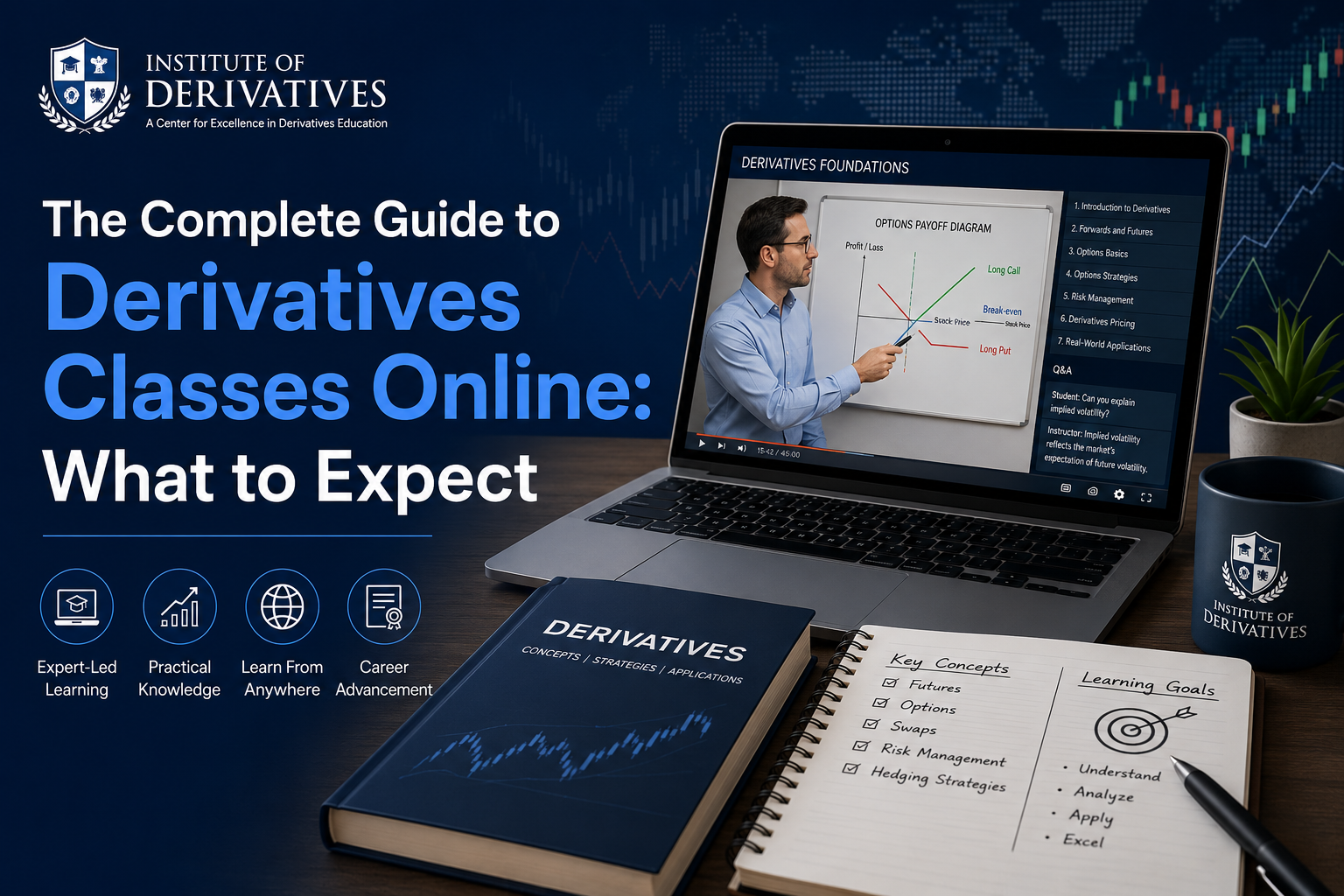
The Complete Guide to Derivatives Classes Online: What to Expect ?



If you have questions about the training programs or the approach, don’t hesitate to contact me directly.